Yandex Leak Ranking Factors and What SEOs Need to Know
The digital marketing world was rocked earlier this year by an unprecedented leak from Yandex, Russia’s dominant search engine. What initially appeared to be a minor internal incident quickly escalated into a treasure trove of information, revealing some 1,922 ranking factors used by the tech giant. For search engine optimization (SEO) professionals, this wasn’t just a fascinating glimpse behind the curtain of a major search engine; it was a rare opportunity to confirm existing theories, dispel myths, and gain fresh insights into how algorithms assess and rank websites.
The files, reportedly from a former Yandex employee, included a substantial portion of the company’s internal source code and documentation. This wasn’t a casual data dump but a detailed blueprint of how Yandex evaluates websites, processes queries, and ultimately decides what content to present to users. While Yandex operates primarily in the Russian-speaking world and has a distinct market share, the principles and mechanisms revealed bear striking resemblances to what many suspect about other major search engines, including Google. The leak has sparked intense debate and analysis across the global SEO community, forcing many to re-evaluate their strategies.
Understanding the Yandex Leak’s Core Insights
At its heart, the Yandex leak underscored the complexity and multi-faceted nature of modern search engine algorithms. It became evident that ranking is not dependent on a few magic bullet factors but rather a sophisticated interplay of hundreds, if not thousands, of signals. These signals range from technical website health to user behavior metrics, content quality, and external link profiles. The sheer volume of factors highlighted the holistic approach search engines take to understand and serve user intent.
One of the most significant takeaways was the emphasis on user satisfaction. While SEOs have long preached the importance of user experience, the Yandex data provided tangible evidence of how extensively user signals are integrated into ranking decisions. This includes metrics like click-through rate, time spent on page, bounce rate, and return visits. These aren’t just vanity metrics; they are direct indicators of how valuable users find a piece of content or a website.
Key Ranking Factors Uncovered by the Leak
The leaked data provided specifics that had SEOs poring over spreadsheets and code snippets. Here are some of the most notable categories of ranking factors that emerged:
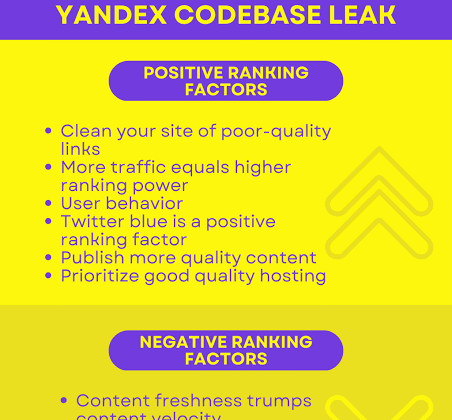
- User Behavior Signals: Confirmed as critical. Factors like click-through rate (CTR) from search results, average time on page, bounce rate, and repeat visits were heavily weighted. The algorithm actively monitors how users interact with search results and websites. If users click on a result and quickly return to the search page, it’s a negative signal.
- Content Quality and Relevance: The algorithm clearly prioritizes content that is comprehensive, unique, and directly answers user queries. Factors related to content uniqueness, amount of text, update frequency, and the presence of relevant keywords (but not keyword stuffing) were significant.
- Host and Technical SEO: Website speed, mobile-friendliness, secure (HTTPS) connections, and server reliability were all confirmed as important. A slow or unreliable website negatively impacts rankings. The Yandex leak also emphasized the importance of a clean sitemap and proper robots.txt configuration.
- Backlinks: While the era of purely quantitative link building is fading, the leak confirmed that backlinks remain a vital signal. The quality, relevance, and authority of linking domains were paramount. Links from spammy or irrelevant sites could actively harm rankings.
- Domain Authority and Trust: The age of a domain, its historical performance, and overall perceived authority play a role. Websites with a long history of providing quality content and a strong backlink profile tend to fare better. This also ties into the concept of E-A-T (Expertise, Authoritativeness, Trustworthiness).
- Commercial Factors: For e-commerce sites, factors like product range, pricing, delivery options, and customer reviews were found to influence rankings, especially for transactional queries. This underlines the algorithm’s goal to provide users with the best possible commercial experience.
Similarities and Differences with Google SEO
While the leak pertains specifically to Yandex, many in the SEO industry believe that a significant portion of these insights are transferable to Google. Both search engines aim to serve the most relevant, high-quality content to their users, and it stands to reason that they would employ similar methodologies to achieve this goal. User behavior signals, for instance, are widely believed to be a major factor in Google’s algorithm, just as they are in Yandex’s.
However, there are also subtle differences. Yandex, for example, appeared to place a slightly higher emphasis on certain host characteristics and older domain signals compared to what many believe about Google. Furthermore, Yandex’s approach to local search and regional relevance might also have unique elements tailored to its specific market. Still, the overwhelming consensus is that the leak reinforces fundamental SEO principles rather than revealing entirely new paradigms. The complexities of search engine algorithms often share common ground across different platforms.
What SEOs Need to Know and Do
For search engine optimization professionals, the Yandex leak is less about pivoting strategies entirely and more about reinforcing existing best practices and providing data-backed validation for long-held assumptions. Here’s what SEOs need to take away:
- Prioritize User Experience (UX): This is not negotiable. Websites must be fast, easy to navigate, mobile-friendly, and provide a clear, positive experience for visitors. Measure time on site, bounce rate, and conversion rates rigorously.
- Focus on Exceptional Content: Create high-quality, comprehensive, and unique content that genuinely answers user queries and provides value. Don’t just target keywords; understand the intent behind them. Regularly update and refresh your content.
- Master Technical SEO: Ensure your website’s technical foundation is solid. This includes optimizing for speed, having a secure HTTPS connection, ensuring proper crawlability and indexability, and fixing any broken links or errors.
- Build a Natural Link Profile: Focus on earning high-quality, relevant backlinks from authoritative sources. Avoid manipulative link schemes, which the leak confirmed can be detrimental. Think about how your content naturally attracts links.
- Monitor and Adapt: Search engine algorithms are constantly evolving. SEOs must stay vigilant, monitor their analytics, and be prepared to adapt their strategies based on performance data and industry updates. Continuous learning is key to effective digital marketing strategies.
- Consider Local and Regional Nuances: If operating in specific geographic markets, pay close attention to local SEO signals, reviews, and region-specific content. Yandex’s emphasis on regional factors could be a hint for other engines as well.
The Broader Impact on the SEO Industry
Beyond the immediate tactical insights, the Yandex leak has spurred a broader conversation about transparency in the search industry. While search engines guard their algorithms closely for competitive reasons and to prevent manipulation, this incident offered a rare moment of clarity. It reminded the industry that despite the complexity, the core mission of search remains the same: to connect users with the best possible information and resources.
The leak also served as a stark reminder of the global nature of SEO. While Google dominates many markets, understanding how other engines like Yandex operate provides a more complete picture of the landscape. It encourages a less Google-centric view, prompting professionals to consider the broader principles of information retrieval.
In conclusion, the Yandex leak was a significant event, offering an unprecedented look into the inner workings of a major search engine. It didn’t rewrite the SEO playbook, but rather provided strong validation for many long-held beliefs. For those dedicated to improving online visibility, the message is clear: focus on creating a technically sound, user-friendly website with outstanding content, and cultivate a natural, authoritative online presence. These are the timeless principles that algorithms, whether Yandex’s or Google’s, continue to reward.